Kira Cruz

I came to Catalina from the International School of Monterey. I didn’t know anyone, I was super shy, and I didn’t want to be at Catalina. Not many people from my school had gone to Catalina, so it was extremely difficult for me to adjust. I didn’t feel comfortable with the amount of wealth people had, nor the Catholic environment, since both of those were foreign to me. I thought I would leave sophomore year, but I decided to stay because of all the friends I made. As soon as I immersed myself in the Catalina community, I started to “fit in,” I guess you would say. I made more friends, felt happier, and was doing well academically. Yet I still felt like a fly on the wall. I didn’t think my presence in classes was significant,, nor did I feel confident about my opinions or ideas. I was just floating around unaware of my surroundings which put me into a dark state that I didn’t think I would be able to come out of. It wasn’t until I ran for sophomore vice president that I really came out of my shell. I gave my speech in front of my entire class, many of whom I didn’t know, and I won. And actually, I also ran unopposed, so that helped. Still, this leadership position really helped me with my public speaking skills and helped me meet more people and connect with more of my peers.


After four years here, I couldn’t be more grateful that I came to Catalina. I owe so much to this school. The connections I have made can never be replaced. The friendships I have made are so dear to me that I want to cry thinking about the fact that we only have 29 days left. Sure, I’m stoked to graduate, but I don’t want to leave this place and stop seeing all of my friends every day, sitting on the couches, leading assembly, and just the campus itself, because it is so beautiful. I love my friends so much. They are my family. Since I come from a super small family, just my mom and me, it was really important for me that I make lasting friendships. I can honestly say that I have so many sisters now. I had never really felt the love of other people than from my family before until I made friends at Catalina. I am eternally grateful for playing field hockey with Giselle for four years, because she taught me to stay true to the sport I love and will be playing in college, I am grateful to Allie for always putting a smile on my face even when I’ve had the worst day possible. This not only helped improve my mood but helped me feel whole again. I am blessed that I have had Taylor in my life because she has been my best friend for four years. I don’t know what we are going to do being so far apart. We have talked about it and we can’t even imagine being three thousand miles apart. Also to Nikki and Keona, thank you for helping me grow more confident on the field, in life, and for always being there for me even if we don’t talk every day. There are countless others because I love my whole class, but I’m going to stop before it makes me more emotional.


Loleï Brenot

“This too shall pass” is a mantra that has run through my mind constantly since my sophomore year. I typically think of it several times a day. It serves as a reminder to be mindful of two things: to treasure the good moments and get over the bad moments, because they are just that—little snippets of time that are fleeting.


However, on March 28, with only 59 days until graduation, I completely lost sight of this. Three days earlier, I had been admitted to the school of my dreams—the University of Southern California. When I received my acceptance package in the mail, I immediately broke down sobbing. I felt that all of my hard work had been validated, that the sacrifices I made had been worth it, that my consumption with the college process had finally been vindicated, and that my goal of attending a top, prestigious school had paid off, a goal I have had ever since I learned what college was. It was much more than just an acceptance for me, because everything became unquestionably all worth it when I received that red acceptance folder printed with the words, “Welcome to the Trojan Family.” I had never been as happy in my life, and for the next three days, I could not wipe a smile off of my face, thinking only of my next cardinal-and-gold colored years. My family and I were so excited to join the Trojan family together.


However, on March 28, my financial aid information was released, and we learned that it would be impossible for me to attend the school of our dreams. To put it lightly, I was absolutely, phenomenally crushed. While I had felt just three days earlier that all of my hard work had been validated, that the sacrifices I made had been worth it, I was now overwhelmed with the opposite feeling, because to me, college was much more than the next stage of life or education: it represented all that I had put into Catalina for the past 14 years. To me, it represented my life up until this point. And then, my goal of years was yanked out from under me in one fell click of the refresh icon on my financial aid page.


Now, I am a generally happy person who finds joy in most things, but I fell into a period of wallowing in self-pity at this point that I did not come out of for a good while. My failure to truly reach my goal consumed almost every thought of mine, even if I didn’t outwardly, constantly show it after the first few days. I lost the joy in the little everyday things I had so appreciated and been mindful of before. Instead of celebrating the countdown to graduation and all of the hard work my class and I put in to get there, I dreaded it, because graduating from here meant that I would have to move on to a place I had no desire to go. While I was so fortunate to have been offered an excellent scholarship at a beautiful school, and while I knew that some people would have killed to be in my position, I was completely overcome by my sorrow and disappointment instead of reveling in the last times I would get to spend here at Catalina as a student.


Now, you may be a little confused, because you know that I am attending USC next year. I discovered on April 15 that my dream actually could be made possible, and I am indescribably grateful for this opportunity and that everything worked out in my favor. However, I still want to say what I planned to when I wholeheartedly believed it would be impossible for me to attend USC and that everything I had done up until this point had seemingly not paid off.


Catalina has offered me more than I can ever express, and it is hard for me to talk about because I love it so much. Despite the stress, late nights, and tough times, there is not a single thing I would change about my experience, even though after discovering I would not be able to attend USC, I wanted nothing more than to rewind the clock to get all of my time and effort back. But I now know that everything I did was worth it, not because of whatever college I will end up at next year, but because it is here that I have created a family made up of peers, faculty members, and teachers—people I can rely on in good times and bad, people who have shaped me, supported me, and people who I truly hope to have in my life until my last days. It is here that I learned how to spell my name and do my multiplication tables, here that I learned a little bit of statistics and biology, here that I learned how to formulate a strong argument, how to speak in public and be a leader, how to do well and do good, and that Catalina girls truly can. Catalina is my home, and without my hard work and many wonderful experiences here, I would not be who I am today or have created the friendships, bonds, and memories that are now so dear to me.


So, especially after experiencing the little bump in my road of almost not getting to attend my first-choice college, I always, always try to keep in mind, more than ever, “This too shall pass.” I hope that you can keep that in your own mind as you move forward. At your lowest point, know that that moment is fleeting. And at your highest, know to treasure that moment, because you will never have it again. Don’t dwell on the bad. Embrace the good. Treasure every single moment you have left here with love, with gratitude, and with care, because it will be over before you know it, and I promise you: you will miss it, and it will all have been worth it.


Audrey Bennett

Having a big red reminder of how many days left I have here has altered my perception of our campus. Walking to classes with that number in my head has made me realize how much this 30-acre plot of adobe and rose gardens has influenced who I am today.

In these classrooms, I learned to look for nuance and to voice my opinion. In this library, I learned that the harder you work, the luckier you get. On the cross country course, I learned I need to get out of my comfort zone in order to get better, and that the most important workouts are the ones you do when it feels like the last thing you want to do. In this dining hall, I learned that sometimes the best medicine is soup in a bread bowl and laughing with your friends. In these offices, I learned the power of having people who care about you and believe in you. At the kiosk, I learned to never trust an automatic gate in a power outage. In the PAC, I learned the joy of being part of something bigger than myself. On the softball field, I learned the value of not being afraid to try something new. In this chapel, I learned the importance of self-reflection. In this gym is where I learned that leadership is not built on superiority but rather understanding, and that hard work and positivity are infectious. On windy field trips to the tide pools, I learned that curiosity will take you far and that asking questions is sometimes more important than knowing the answers. In study hall, in the midst of sister speeches, random dance parties, and frees spent on the couches, I learned that I have not just two sisters but two hundred.

As I look forward past these 30 days or so, past the scent of roses in the air and past the long stretch of summer ahead of us, I am nervous about defining my identity at a completely new place, with 8000 acres instead of 30 and more palm trees than rose gardens. These past four years my identity has been so intertwined with these 30 acres, with these classrooms, this chapel, these sports teams, these people. As scary as it is to uproot, I realize that I will always keep my experiences here as an integral part of my identity. I learned that Catalina is more than just a place and a ring on my finger; it is part of who I am now, and no matter where I am, I will always keep Catalina and the people here close to my heart.

Workingwomen: Obstacles and Notions by Loleï Brenot

1920 marked a turning point for women in the United States. Susan B. Anthony, Elizabeth Cady Stanton, Lucy Stone, and too many other women to name were finally heard and granted the right to vote. However, while women then had the same rights for the most part as a man in the eyes of the federal government, people did not become gender blind. Only 11 years after the 19th Amendment was passed, Virginia Woolf penned a powerful piece on society and its expectations of women in the workforce. Woolf commented, “Even when the path is nominally open—when there is nothing to prevent a woman from being a doctor, a lawyer, a civil servant—there are many phantoms and obstacles, as I believe, looming in her way,” showing that preconceived notions about women being the weaker sex still ran rampant. This is still true today.

Despite being legally recognized as fully equal to men, women still face numerous obstacles in their careers today due to unfair perceptions regarding women, or familial duties many women feel responsible for, similar to what Virginia Woolf observed and wrote about in the early the 20th century.

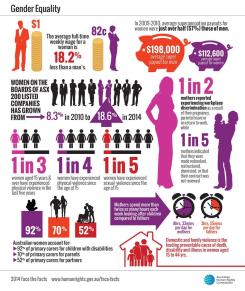
Double standards and unfair expectations when hiring or evaluating women at work must still be overcome by teaching children from a young age that all people are equal and that; in general, standards and expectations for all should be the same. While there is American legislation ensuring equal opportunity and pay for women in the workplace, such as the Fair Labor Standards Act, the Department of Labor’s Women Bureau, and the Equal Employment Opportunity Commission, there are still structural biases in the system. Under the seams of the corporate world, there is the dark underbelly of discrimination. In a 2014 study by the Australian Human Rights Organization, countless biases were uncovered in the Australian workforce. The results of this study reflect similar conditions in the United States and Western world and are depicted in the pictograph above. Additionally, other statistics on the subject of gender inequality in the workplace were covered in Sheryl Sandberg’s 2010 TED talk. According Sandberg’s TED talk, “Why We Have Too Few Women Leaders,” only nine out of 190 heads of state globally are women. No more than 16% of women in the corporate business world hold high-level positions. These statistics show just how grave the subject of gender inequality is and just how important it is to overcome.

Women are not only held back by others, but are also held back by self-made perceptions and by their own personal sense of need to personally care more for their families, which in most women is greater than in men. Although this is certainly not the case for some, men are seen as prestigious when they accept more demanding work commitments, whereas a woman who accepts a demanding commitment is often looked down upon for sacrificing her family life for her career.

Working women are currently in a career limbo, where women who elect not to have children are judged, working mothers are gossiped about for not keeping their families in mind, and non-working mothers are seen as antifeminist women with no ambition.

Women face more difficulty in being hired and promoted, as seen in a 2016 Women in the Workplace study, which shows that for every 100 female promotions, 130 men are promoted. This provides great insight into the hiring process. As is supported by other research as well, employers are less likely to promote women because women are less likely than their male colleagues to push for a promotion or even accept one when offered due to their familial sense of duty. These commonly held perceptions make it nearly impossible for one to find a correct balance in society’s eyes. On top of drastically holding fewer top company job positions, per the statistics mentioned before, the few high-achieving women who do make it to the top are often then judged harshly, being held to different and more judgmental standards than their male counterparts. Often labeled as “aggressive,” “bossy,” or even “bitchy” for simply doing their job and trying to push past gender discrimination barriers. Women naturally and unintentionally do not always put themselves out there or first in the workplace. 57% of men negotiate for their salary in their first entry-level job, while only 7% of women do so. This double standard that forces women to prove themselves by working harder than men is a key barrier to equality in the workplace and is a “phantom [or] obstacle” as Virginia Woolf would say.

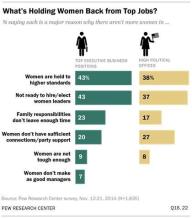
Workplace and hiring discrimination against women, whether purposeful or unintentional, must be ended, as these are what prevent full gender equality from being reached. According to a 2014 PEW Research Center survey, a large reason why women are held back from “top jobs” is that females are held to a higher standard than men. The survey also shows data that supports the fact that women are held back because of employers who are unwilling to hire females, female family responsibilities, the perception that women are not “tough enough” or good managers. These perceptions are the ones that must be overcome in order to achieve full workplace equality and are precisely what Virginia Woolf spoke about in her essay. These hidden biases are the roadblocks that have been present since the early 20th century when women began to enter the workforce.

Virginia Woolf’s words from 1932 still pertain to the world today, as women work to overcome both outside and personally imposed workplace and familial expectations and perceptions. Pre-conceived notions of workingwomen color their ability to succeed in business and the corporate world; however, these can be overcome through thoughtful education and professional conduct. Although Virginia Woolf’s words, “there are many phantoms and obstacles . . . looming in [a woman’s] way,” still ring true today, there is a bright future ahead for women in the workplace and in the world.

Sources

  1. http://www.history.com/topics/womens-history/19th-amendment
  2. http://omegahrsolutions.com/2012/01/the-5-significant-u-s-labor-laws-for-women-to-know-about-a-guest-post.html
  3. http://www.pewsocialtrends.org/2015/01/14/women-and-leadership/
  4. https://womenintheworkplace.com
  5. https://www.dol.gov/wb/map/
  6. https://www.ted.com/talks/sheryl_sandberg_why_we_have_too_few_women_leaders/transcript?language=en
  7. http://fortune.com/2016/01/17/women-held-back-workplace/
  8. https://www.theguardian.com/women-in-leadership/2015/sep/01/the-three-things-holding-women-back-at-work
  9. http://www.economist.com/blogs/democracyinamerica/2015/01/women-and-work
  10. http://www.npr.org/2016/10/18/498309357/too-sweet-or-too-shrill-the-double-bind-for-women
  11. https://www.dol.gov/wb/stats/most_common_occupations_for_women.htm
  12. https://hbr.org/2013/09/women-in-the-workplace-a-research-roundup


Drones by Emma Patterson

Drones are the mechanized versions of assassins in today’s world. They execute highly dangerous tasks with incredible accuracy, and they are able to do so without a trace of humanity.

It is often forgotten that behind those drones are people who will, in time, be overcome by the sense of guilt and responsibility for the deaths they caused; thus, the question of morality is not as far removed than previously advertised.

The argument for drones appeals to logic and a goal to be the most militarily advanced state in the world; however, the argument against drones is equally compelling, and possibly more complex, as it appeals to our humanity and forces us the take responsibility for the lives we end, no matter how far removed we are from the damage done.

The argument for drones has many valid aspects that generate a reason for pause on the idea that drones are purely vehicles of death and destruction. We do not just reserve drones to attack foreign threats.  We have targeted and killed at least four known American citizens who threaten our security (4). The whole process must be approved through several levels of our government, including the president, National Security Council, and CIA (4).  Drones are not as expensive as many other methods our military uses, which leaves more money to help education, health care, and foreign aid (3). Drone operators watch their targets for hours.  They are able to track the presence of civilians around them, and have the ability to change the course of a missile, if the situation changes (5).

Drone operators have said that they are not just heartless killers; they take the time to be as careful as possible to protect civilian life (2).

According to the Long War Journal, 2,706 Taliban and al-Qaeda soldiers have been killed by drones in Pakistan, while only 156 civilians were a part of the cost (2). Since the U.S. military refuses to comment on drone activities, the conversation is often dominated by those who oppose the use of drones.  This leaves room for many valid reasons for the legality of drones that we may not be able to highlight, as they remain classified by the Justice Department (2).

The argument against drones appeals to humanity and makes any rational person contemplate the destruction that these machines have the possibility to breed. Among the deaths, several have been of children. A Stanford/NYU study showed that the strikes have added to trauma for the residents of Pakistan. The study suggested that relief workers no longer wanted to serve in targeted areas because of the threat of a drone strike and a lack of faith in the government to protect civilians (4). Drones have become a suitable substitute for bombing and capture as shown by the hundreds of terrorist suspects killed under Obama, and one captured (5). The reasons that drones are considered illegal is classified, and for many people that was not an acceptable response. Lawsuits filed to expose these reasons have been unsuccessful (4). Operators have recounted the horrors of killing a person that you have monitored for days. They find they know their victims significantly more than the old bomber pilots used to, so they are more aware of what is at stake (2).  They speak on the idea that their targets are presented to them as some sort of a video game in which the object is to kill, but they feel this assumption of an alternate reality is false. They all understand that their targets are real humans and there are real life consequences that their actions will have (2). Many pro-drone activists discredit the notion that the operators will develop severe PTSD from their efforts; however, these claims hold no water, as the operators are still human and are highly aware of the human lives they take (3). The operators watch hours of carnage take place in front of them, while manned aircraft pilots only spend moments in the area of destruction.  The drone operators also spend their time in isolation on shifts that take hours; this keeps them from leading a normal, healthy life (5).

The idea that terror groups can push us to the point where we feel justified in becoming the judge, jury, and executioner is a notion that inspires fear in the hearts of people.  

While terrorism does generate intense fear in the American psyche, it is imperative that we evaluate the risk versus reward in all of our actions.  

Creating fear among the civilians in the countries in which we do our work does not aid our efforts to later pave the way for peace and democracy.  All this fear does is create an atmosphere full of animosity towards Americans, and build a barrier between us and a potentially positive relationship in the future with another state.


WORKS CITED

  1. Global Issues: Politics, Economics, and Culture by Richard J. Payne
  2. http://www.huffingtonpost.com/brian-glyn-williams/defending-the-predators-t_b_6248922.html
  3. http://www.thedailybeast.com/articles/2013/02/07/why-our-drone-warfare-campaign-is-right-and-moral.html
  4. https://www.washingtonpost.com/news/wonk/wp/2013/03/08/everything-you-need-to-know-about-the-drone-debate-in-one-faq/
  5. http://www.nytimes.com/2012/07/15/sunday-review/the-moral-case-for-drones.html
  6. http://www.huffingtonpost.com/brian-glyn-williams/defending-the-predators-t_b_6248922.html

The Morality Exception for Celebrities by Ariana Fadel

The life of a celebrity seems glamorous, but as many of us know, a major problem they deal with is the lack of privacy. I can still remember when I first questioned the ethics behind these forcibly publicized lives of celebrities when I was around ten years old: I was bored while sitting in an airplane, so my mom gave me a magazine. As I was leafing through it, I saw an article entitled “Celebrities – They’re Just Like Us!” When I saw the pictures of random actors and actresses getting groceries, sitting in the park with their kids, and doing other equally mundane activities, it finally hit me: they are just like us! More importantly, this also made me realize that if someone were to take these same photos of me, that would be considered stalking. So, if these actors are indeed “just like us,” then why has this moral barrier been crossed and been so widely accepted? Why should this be considered “part of the job,” leaving actors criticized for not accepting this complete invasion of privacy?

The life of celebrities has been acknowledged as its own type of entertainment through the unethical use of the paparazzi, and I believe this is because it has become normalized and that we, as humans, are fulfilling a natural urge to find out as much information as we can about those we are interested in, such as celebrities.

You can find news on celebrities everywhere. For instance, when I go on Snapchat and look at their “Discover” page, a lot of the times it will contain at least one story of simply Kendall Jenner and/or Bella Hadid going outside. Seriously. What it will show is them leaving a restaurant, a fashion show, a club, anywhere. And instantly, upon setting foot outside, they are bombarded with cameras. If they even put a hand up to cover their face, they’re labelled as “defensive.” The lives of celebrities have become amusement – all privacy compromised – for the general public, including myself. I would not consider this great amount of the population that reads celebrity news as fundamentally immoral, however. I believe that the paparazzi, which is actually the equivalent of professional stalking, has been normalized for our generation simply because it is so accessible. If it is everywhere and practically no one is protesting it, then it cannot be wrong, right?


To put it simply – no. If you’ve taken philosophy or read Socrates, you could compare this to Socrates’ teaching that popular opinion does not necessarily mean right opinion. And that is the case here.

We have come to view celebrity stalking as acceptable simply because everyone else is fine with it, which is understandable but still wrong.

We have to change this view and give celebrities, who are people “just like us,” their right to privacy.

I believe there is a definite psychological aspect to the stalking of celebrities. In fact, I think the urge to find out all this information on this select group of people is natural. This can be seen in a common practice that our generation engages in today: Instagram stalking. Most of us do it: we click on one person’s profile, scroll through their pictures, look at one picture, click on the account of a person tagged, look at their profile, and then keep going until we have forgotten where we are and feel gross and ashamed. This is just like celebrity stalking – we are slightly interested in the person for whatever reason, so we decide to learn more about them. This may have to do with some animalistic urge to compete, mate, or something of that nature – what I can conclude at the moment is that this is quite normal.

In fact, the only reason our grandparents did not do the same thing is because they did not have access to that kind of technology. What they would do instead was gossip and ask around, talk to friends, etc., in order to learn about whoever they were interested in – another form of “stalking.” While we still do that today, we have easier means such as Instagram. Again, accessibility is key to why stalking has been normalized – but also, we are appeasing a natural instinct in us to find out as much as we can about someone we are interested in.

The only thing that truly differs from celebrity stalking and the stalking of regular people on Instagram is the lack of shame we feel after stalking a celebrity. As I stated before, often we feel embarrassed with ourselves after stalking regular people on social media. Imagine liking an Instagram picture from twenty weeks ago on a regular person’s account in comparison to liking that same picture on a celebrity’s account. The first would probably send you into a panic, while the the second was probably intentional. We become only a number in a celebrity’s huge amount of fans which means that any action we take, including stalking them, is hidden in the crowd.

We are so distanced from them that nothing we do to them could ever come back and hurt us, whereas (to continue the Instagram example) if we were to like a regular person’s old picture on Instagram we would stick out as their only stalker.

This means that they could call us out for it. With celebrities, there is no fear of being noticed for stalking simply because there are so many people doing it. The fact that this is the only reason we feel secure stalking a celebrity versus a normal citizen goes to show that stalking a celebrity really should not be any different from a normal person in terms of ethics. There is no moral reason that we feel we can stalk the famous – it all comes down to the fact that, with celebrities, we can get away with it.

I believe it is indisputable that all humans realize it is, to put it lightly, uncomfortable to be stalked. This realization sadly seems to be lost when applied to celebrities, however, due to the  normalization and accessibility of stalking over the years. It has become ingrained in us that stalking is normal for celebrities and should be fine with the celebrities because it is so accessible and everyone does it. Stalking, however, is a natural compulsion, and I believe that as long as it is not actually compromising that person’s rights, it should not be outlawed or anything of that matter. There is no doubt that it is embarrassing and a bit weird, but sure – go stalk that person on Instagram. There are different levels of stalking, however – it can be harmless, or it can alter someone’s life completely.

What I do think is completely morally wrong and should be fought against is the whole idea of paparazzi.

I believe it is the equivalent of professional illegal stalking. The person who is subject to paparazzi has their right to privacy taken away and their freedom becomes limited in the process of celebrity news, turning their life into entertainment for the bored civilian. The whole idea of the paparazzi is immoral and has to be dealt with as it hurts people. These people are celebrities, yes; but this does not diminish the fact that they are real people with real feelings and real lives to live.
But, in recognizing this grand dilemma, we are left with a new and extremely difficult question – how does one get rid of the paparazzi?

My Talk on Racial Justice by Taylor Moises

This is a talk I gave to the Filipino Women’s Club of Salinas last year on September 9th. I spoke about the racially motivated shootings that have been brought to national attention along with the response of the Black Lives Matter movement. My goal was to bring awareness to my community and to start a conversation about this national issue. Before speaking to the women, I was aware of the prejudice some Filipinos have as a minority group who experience less severe racial prejudice. After the talk, many expressed their support, but those who expressed their disagreement were the more powerful voices. Their responses reassured me that having this conversation is important. Although this was months ago (and Black History Month was last month), it is topically relevant especially for those taking Peace and Justice since we are currently reading Dr. Martin Luther King Junior’s Strength to Love and are discussing racial justice.


Thank you for letting me come and speak to you all. Hello, I’m Taylor Moises. My mom, Vivian Moises, is a member of the this club and I have attended some meetings before. I requested to talk to you all today about the police shootings of African Americans that have been occurring across America and the Black Lives Matter Movement that has grown in response to the shootings.

Many, if not all of you, are probably asking a few questions in your head right now: why am I, a Filipino-American teenager from Salinas, concerning myself with this issue? Why am I here speaking with this club for Filipino Women about the Black Lives Matter movement?

Basically, What does this have to do with me or you?

It’s logical to be weary or confused as to my motives to speak here today, but I ask you please listen to what I have to say with open-minds and empathetic hearts.

Before I go any further I would like to stress that this is a complicated issue and there is no simple black and white answer. Also, being pro-black lives is NOT an opposing view to being pro-cop. I have relatives who are cops and relatives who are black. I do not support cops who unjustly shoot people but I do not want them shot down either. I want fair trials for policemen.

Within the past few years racially-motivated shootings have been brought to national attention. I don’t know how closely you have been following them, but if you’re like me, you might remember having heard vaguely of Trayvon Martin, Eric Garner, and, more recently, Alton Sterling and Philando Castile. It was the last two shootings of the men I just mentioned, Alton Sterling and Philando Castile, that sparked a need in me to investigate this national concern.

Just to refresh your memories or explain to those who have not heard about them, earlier this summer in Louisiana, two White police officers killed a Black man named Alton Sterling while he sold CDs on the street. The very next day in Minnesota, a police officer shot and killed a Black man named Philando Castile in his car during a traffic stop while his girlfriend and her four-year-old daughter looked on. The shootings were recorded and published to the public.

After watching the videos of both shootings, I was brought to tears because I was witnessing injustice that I could not and cannot tolerate.

I immediately began researching what I could do to show my support to the victims and their families. This led to researching more on the Black Lives Matter movement, past police shootings, research done on racial profiling, and examining collected data to become familiarized enough to make educated responses to the events. I wanted to find the most beneficial way for me to actually make a difference.

My goal is reasonable. I decided a good place to start is in my own community of my city, Salinas, and my community of Filipino women. I want to spread awareness of this national issue of racially motivated shootings. And while there is the argument that most of the shootings are not racially motivated or we don’t have a problem of police shootings, discrimination and racism is still a problem throughout our country. I am here today to inform you all of this national concern and to make our Filipino community in Salinas aware of the racism that we can unknowingly take part in.

This year, American police have already killed more than 600 people. Of those, 25% have been Black, even though Black people make up only 13% of the population. Overwhelmingly, the police do not face any consequences for ending these lives.

Even as we hear about the dangers Black Americans face, our instinct is sometimes to point at all the ways we are different from them. To shield ourselves from their reality instead of empathizing. When a policeman shoots a Black person, you might think it’s the victim’s fault because you see so many images of them in the media as thugs and criminals. After all, you might say, we managed to come to America with nothing and build good lives for ourselves despite discrimination, so why can’t they?

It’s true that we can face discrimination for being Filipino in this country. Sometimes people are rude to us about accents, or withhold promotions because they don’t think of us as “leadership material.” But for the most part, nobody thinks “dangerous criminal” when we are walking down the street. The police do not gun down our children and parents for simply existing.

Many Black people were brought to America as slaves against their will. For centuries, their communities, families, and bodies were ripped apart for profit. Even after slavery, they had to build back their lives by themselves, with no institutional support—not allowed to vote or own homes, and constantly under threat of violence that continues to this day.

In fighting for their own rights, Black activists have led the movement for opportunities not just for themselves, but for us as well.

For all of these reasons, I support the Black Lives Matter movement – The movement made after Trayvon Martin’s trial which resulted in his killer not being held accountable for the crime “in response to the anti-black racism that permeates our society.” Part of that support means speaking up when I see people in my community—or even my own family—say or do things that diminish the humanity of Black Americans in this country. I’m asking that you try to empathize with the anger and grief of the fathers, mothers, and children who have lost their loved ones to police violence.

Recognizing that racism and racially motivated shootings are issues is the first step. Thinking before saying things that may not mean to be hurtful, but could be interpreted that way, is also good to practice. I am not accusing any of you of being racist but I would like to address the inherent belief of certain people being inferior due to their skin tone. This still pervades today, even if does not stand out as it did fifty years ago.

Just because you are not prejudiced on purpose, does not make you immune to being racist.

Some people are prejudiced because they are evil, and some people are prejudiced because they don’t know better yet.

Saying racial stereotypes or using racial slurs is unacceptable in any form and is a form of racism.

It is important that we do not diminish the Black Lives Matter movement because we are equally capable of being both oppressors and allies. “We’re all susceptible to internalizing anti-Blackness, but we are not holding ourselves accountable when we pretend that white supremacy is the sole reason for our faults.”

Saying “All Lives Matter” undermines the Black Lives Matter movement.

BLM does not mean other people’s lives don’t matter; it does not mean black people are superior. The movement is to recognize that black people are being deprived of basic human rights. It is not to say “black lives are more important than other lives, or that other lives are not criminalized and oppressed in various ways.”

I believe our Filipino Women’s Community is a great community to be a part of and I simply wanted to share my concerns with you and to hopefully bring awareness to this issue that I care deeply about. As I mentioned before, this is not a simple problem with a simple solution. After doing more research, less shootings seem intentionally racially-motivated but the national attention to them has brought the talk of racial justice back to the table and I do not want our community to be left unknowledgeable of this inequality. According to the 2000 US Census, there are .61 more Filipinos (3.88%) than African Americans (3.27%) in Salinas. We are both minorities whose voices deserve to be heard and should not be discriminated against or fear our justice system.

Thank you, again, for letting me speak to you today and I hope this has covered a topic you deem has significant importance. There are different ways to take action in this movement, but being educated on the matter and then being aware of it is the most crucial aspect. Thank you and please have a lovely weekend.

 

How To Be a Perfect President by Iris Kang

Two weeks ago, a president was impeached for the first time in Korean history.

In the five-month process of the impeachment, I was overwhelmed by the information about scandals regarding the president and big political jargon used in the articles. After scrutinizing them, I realized how influential the president’s role is and learned a lot about politics.

Here are some things that led to the impeachment of the first female president of Korea, Park Geun-hye:

The major problem was that she significantly lacked communication with the citizens and was very opaque in terms of running the country and making policies.

Koreans were beyond mad when a news channel reported that the president’s close friend, Choi Soon-sil, had great influence in crucial political decisions without any official government title. For instance, she edited some of the president’s most crucial speeches and pressured the president to appoint certain people to a high government position. Moreover, in order to sponsor her own daughter who was a horseback rider, she pushed the president to extort a huge amount of money from big businesses illegally.

The first article of the first chapter of Constitution of Korea says, “The Republic of Korea shall be a democratic republic,” and continues, “The sovereignty of the Republic of Korea shall reside in the people, and all state authority shall emanate from the people.” Clearly, Park has violated these most basic rules, so of course, people were furious.  Thousands of people came to the boulevard in Seoul with candles to express their anger. Even elementary school students joined the candlelight rally. After a long period of anticipation, the Constitutional court officially removed Park from the office. Currently, Korea is preparing for an election in May.

The impeachment was highly symbolic because it meant that the voice of citizens was finally heard.

One of the most liked comments on the article about her impeachment said: “Justice is alive”. I stopped and pondered over those words. I could not agree more. Despite the scandals, people fought for justice and the winners were the people in the end. The candlelight rallies that have been happening every Saturday for months really did make a change.

Witnessing such a historical moment in Korea, I gained lots of knowledge about politics. Even though I was still not eligible to vote, I was mad when it became evident that the voice of citizens was ignored. That meant my opinions would be ignored. Then, I thought, the only way for me to make change is to be more knowledgeable about politics so that opinions of my generation are acknowledged, and this kind of incident never happens again. I was born and raised in Korea, but I knew very little about Korean politics, if anything, before this incident. Frankly, I was not interested in politics in general. Sometimes, I tried to read some articles and understand what was happening, but it never worked out well. News articles about politics were always unappealing to me because of all the political jargon that I had no clue about. I tried to force myself to read more, but I let go and thought, “Oh well, I guess politics are only for adults. I’ll stay out of it until I get to vote.” When I came to the States, I was afraid that people would ask me questions about Korean politics and I would not be able to answer them. Although I still have a lot to learn, I can say I am more informed now.

After the impeachment, I became aware of how significant democracy is. The president has a huge responsibility to help South Korea become a politically stabilized nation. Being the president is indeed a very challenging job; the president has to listen to everyone’s opinions and come up with the best compensation so that everyone is satisfied. Of course, it will be impossible to form a policy that every single person in the country will be happy with. But presidents should try their best to meet the demands of the majority. Had Park communicated with the people rather than her friend, the people would have been happier with her. She demonstrated that because the president is elected by the people, the president should always keep up with the citizens and be transparent regarding her policies.This is how democracies work.

Now that Korea has taken a step forward towards becoming a stronger democracy, I am looking forward to positive changes.

It’s all about progress and improvement.

In addition, it is about time for me to get involved in politics. I want my voice and the voice of the rest of the rising generation to be heard. Although the process has been rough, the people have proved that the democracy is alive, and the whole incident will have a positive effect on Korea in the long run.

Confirmation Reflection Letter by Isabelle Redfield

I definitely wouldn’t consider myself an open book in general, especially regarding religion. But, a lot of my spirituality has actually come from my being here at Catalina, so considering I probably will never have another chance to talk about my religion in front of a large group of people I actually like, I want to share my honest and unedited letter to the bishop about why I wish to be confirmed in the Catholic Church, because it sort of doubles as a reflection on my time here. It goes like this:

Dear Bishop Garcia,
I have wanted to continue my Catholicism this year through Confirmation for several reasons. Perhaps my most driving force is that I never want to lose faith. I am headed to college next year. I am certain I will lose my way more than a few times. I will no longer be required to show up to Sunday mass, and in many ways I’ll be held less accountable for my actions. I never want to forget or push aside some of the most spiritually formidable moments I’ve had these past four years.
Until Catalina, religion was never incorporated into my schooling or daily life. My parents had me baptized as a matter of course, I had my first communion, and I went to mass maybe six times out of the year when I lived in San Francisco. It was not until my sophomore year here when I really felt the value and the extremely strong connection to God and the saints that I do today.

The simple comfort of having the doors to our Rosary Chapel open at all times has enabled it to serve as my safe space. I’ve cried in those very pews and questioned life, my existence, and my purpose more than you’d think.


I once spent some time with a legitimate horse whisperer and he told me something that has stuck with me forever and that is: “You are 100% responsible for 50% of every relationship that you’re in.” So, my intention in going through Confirmation this year has been to at least try and figure out if I can even get my “relationship percentage” with God up to 10%.  My biggest hope for the future is to one day never see religion as an on-and-off switch. It is so easy for me to connect with God and pray in troubled times when I’m upset, confused, and in doubt. That said, when things are going well in my life, and I am content with where I am, I have much more trouble connecting to God and the saints.

But I no longer want to lean on my faith only in times of trouble; I want it to be present with me at all times.  I truly want my faith to withstand my life’s journey, and I hope that one day my faith will become a more fluid part of me.


I see God in the unexpected places. I remember sobbing in these pews when my grandfather died, when best friend’s dad committed suicide, when I was in the middle of the college application process, and when I’ve been tested in relationships with loved ones. I can distinctly recall a flash of light, a flickering of a candle, and other more personal signs that have made me certain I am not alone.
I have so much hope and expectation for my future. I have so much happiness and love within me. God has blessed me in more ways than I can count. I am extremely thankful. My greatest wish is for God to continue to guide me through times both troubled and wonderful, to bless me in moments both good and bad, and to always be with me—even when I’m in doubt.

It is my promise to God and our world to give back and share the gifts and talents he’s blessed me with.

I hope throughout my life that God continues to instill graciousness, humility, and strength in me. I want to continue to become a better friend, daughter, student, employee, and leader. As I continue to grow, I want to act more softly with more kindness, openness, and love. All around, I am so blessed and could not be more thankful for the life I have been given. I will miss this time in my life, this chapel, and those who have touched me. I will always hold my years here at Santa Catalina deep in my heart, knowing it was my purpose to spend my time here and not anywhere else. I thank you for your time, for the gift of my confirmation, and my future. Please bless me, my family, my loved ones, and those in need.
Lastly, to God, I thank you from the bottom of my heart, even when I don’t express it.

Kindly,
Isabelle Redfield